How we deploy today
Push-based CI/CD. Familiar. Works. But…
The flow
- Merge to
main - Jenkins / GitLab CI runs
- CI pushes to the cluster
- Hope nothing drifted since last time
What lives where
- Git — source code
- CI server — deploy credentials, kubeconfig
- Cluster — the "real" state nobody can see without kubectl
The cracks
- Credentials in CI — Jenkins holds the keys to prod. Anyone with Jenkins access has cluster access.
- Drift — someone
kubectl edits for a hotfix. Git no longer matches the cluster. Nobody remembers. - Rollback = new pipeline run — you're not really rolling back, you're re-deploying an older artifact. If the pipeline is broken, you're stuck.
- No single source of truth — "what's actually running?" requires logging into the cluster.
- Audit = screenshots — compliance asks "prove what was deployed on 12 March." You can't.
Sources: Octopus — State of GitOps 2025 · CNCF — GitOps in 2025
What is GitOps?
An operating model where Git is the source of truth for everything that runs in the cluster, and a controller inside the cluster pulls changes and reconciles them continuously.
It's not
- A product
- A CI pipeline
- Just "putting YAML in Git"
It is
- Declarative desired state
- Pulled by the cluster
- Reconciled forever
Push → Pull
The fundamental flip.
(animation — click Next step to walk through)
The 4 principles
- Declarative — desired state, not imperative steps
- Versioned & immutable — every change is a commit
- Pulled automatically — the cluster fetches, not CI
- Continuously reconciled — drift is detected and corrected forever
(reconciliation loop animation)
Source: OpenGitOps — CNCF Working Group
The declarative gap
Everybody claims GitOps. Few actually do it.
The gap is where the hard work lives — legacy deploy scripts, imperative helper tooling, people reaching for kubectl under pressure. We'll come back to this in "challenges."
The two main controllers
Argo CD 3.x
CNCF Graduated
- Rich web UI — sync status, diffs, rollback
- Centralized governance, fine-grained RBAC
- ApplicationSet for fleets of apps
- Great first impression for newcomers
→ We'll demo this one.
Flux CD v2.8
CNCF Graduated
- CLI-first, minimalist, Kubernetes-native
- OCI-native delivery
- Post-quantum
agecipher for secrets - Lower overhead, no central UI
→ Philosophy, not competition.
Pick Argo CD for UI-heavy, governance-first orgs. Pick Flux when you want Kubernetes-native minimalism and no central control plane.
The broader ecosystem
Around the controllers
- Kargo — promote dev → staging → prod (we'll demo)
- Backstage / Red Hat Developer Hub — internal developer portal
- Kyverno — policy-as-code guardrails
- OpenTofu — community-driven Terraform fork
- Sealed Secrets / ESO / Vault — secrets that can live in Git
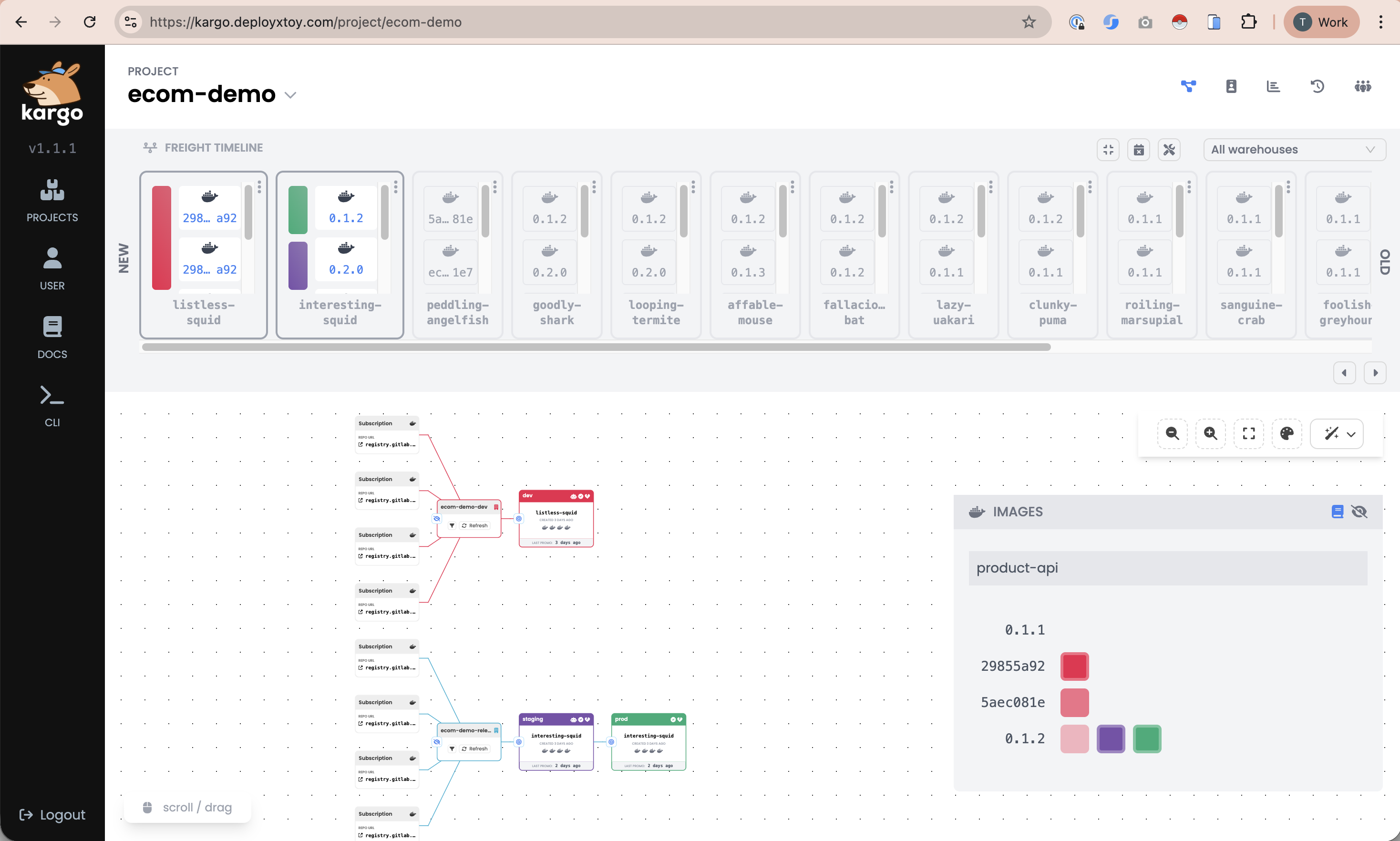
Kargo — the promotion layer
(promotion pipeline animation)
Argo CD deploys. Kargo promotes.
What's new in 2026
One slide on frontier trends — don't get distracted by shiny.
- AI-driven compliance — 75% of orgs projected to use AI in compliance by 2026
- Agentic orchestration — AI agents opening PRs, not just reviewing
- Edge Kubernetes — K3s at Tesla / CERN, <100 MB footprint
- Sovereignty — SNCF & EU orgs abstracting from US-cloud lock-in
- 80% of orgs expected to run an Internal Developer Platform
- Continuous compliance — audit baked into the pipeline, not retrofitted
Argo CD — applications view
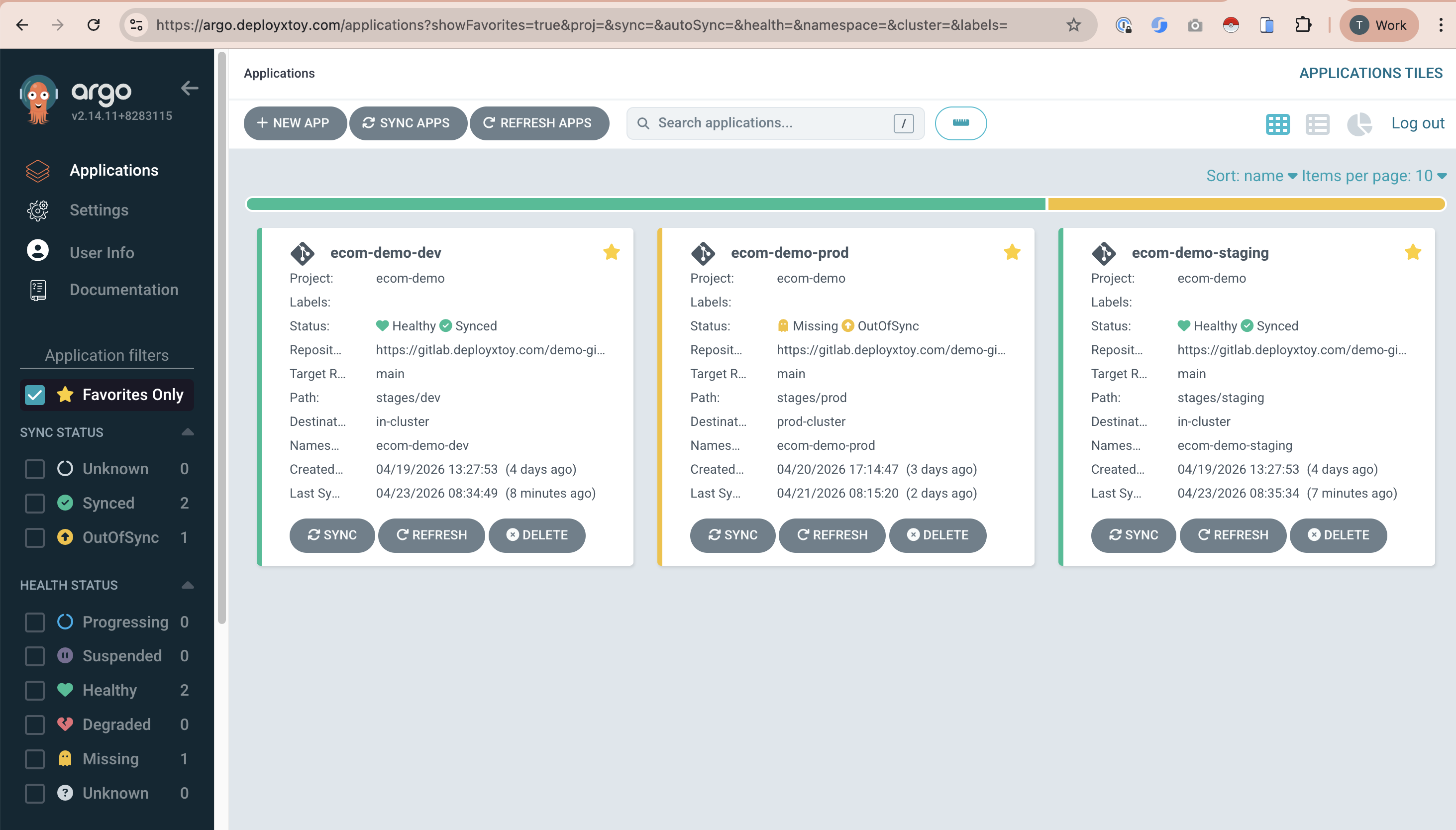
Drift detection — what we'll see
- We'll
kubectl edita running deployment - Argo CD marks it OutOfSync
- Auto-sync (or manual click) reverts to Git state
(drift → self-heal animation)
Kargo — promoting a freight
DORA metrics — before / after
The four indicators of elite engineering organisations.
(animated bar chart)
Source: DORA (Google Cloud) · 2025 DORA Report
What the field reports
Sources: CNCF Annual Survey 2025 · State of GitOps 2025
Before / after — what changes
Before
- Incident — page human, rerun pipeline, hope
- Rollback — a new deploy of an old artifact
- Audit — screenshots, tribal knowledge
- Access — shared kubeconfigs, rotating Jenkins creds
- Env parity — "works on staging"
After
- Incident —
git revert; cluster self-heals - Rollback — Git history, one commit away
- Audit — Git log is the audit trail
- Access — nobody holds cluster creds; controller does
- Env parity — same manifests, different values files
Developer velocity — what stays, what improves
Unchanged for developers
- Same IDE, same branches
- Same PR workflow
- Same CI for build, test, image push
GitOps replaces the deploy step only. Pipelines get shorter, not rewritten.
What improves
- Self-service via Internal Developer Portals (Backstage / Developer Hub)
- Env provisioning via PR — no ops ticket
- Promotion via Kargo — no bespoke promotion scripts
- Fewer "please deploy this for me" asks to SRE
It's not free — what we'll hit
- Cultural change is the real blocker — 47% of adopters call it #1. "ClickOps under pressure" is a habit, not a tooling problem.
- Stateful workloads & DB migrations — genuinely hard. Atlas Operator, Argo Hooks, init containers. Plan carefully.
- Git platform outages — 330 DevOps platform outages in H1 2025 alone. Mitigations: local controller cache, multi-remote.
- Secrets management — you can't just commit them. Sealed Secrets, External Secrets Operator, Vault. Pick one early.
- Skill gap — declarative thinking is a learned muscle. Budget for training time.
Sources: State of GitOps 2025 · CNCF — GitOps in 2025
The "slow-slow-fast" path
From the field — this is how successful teams adopt GitOps.
- Slow — pick one app. Non-critical, declarative-friendly, representative. Stand up Argo CD. Migrate deployment only.
- Slow — polish the muscle. Let the team learn the pull-based mental model. Document the "break the glass" procedure. Measure before/after DORA.
- Fast — scale the proven pattern. Add ApplicationSets, bring in Kargo for promotion, onboard more teams with a portal (Backstage).
What kills adoption: "let's migrate everything in Q2." Nothing ages a GitOps initiative faster than trying to boil the ocean.
What this looks like for us
This quarter
- Pick one candidate service (suggestions welcome)
- Stand up Argo CD on our dev cluster
- Migrate its deploy step from GitLab CI to Argo CD
- Baseline DORA metrics before
Next quarter
- Add Kargo for dev → staging → prod promotion
- Pick a secrets strategy (ESO or Sealed Secrets)
- Measure DORA after. Share results.
- Decide: expand or pause.
Small enough to fit around normal work. Large enough to learn whether GitOps suits us.